
Our rules
Three rules we wouldn't break.
No fairy dusting.
Every active dosed at the level the research actually uses — not the level that looks good on a label.
No claim we can't back.
Every benefit on this page is backed by peer-reviewed research, cited at the bottom. If the science isn't there, neither is the claim.
No filler theatre.
No sugar. No hidden caffeine. No colours, no taurine sprinkles, no exotic adaptogens at homeopathic doses.

What's in it
What's actually in the stick.
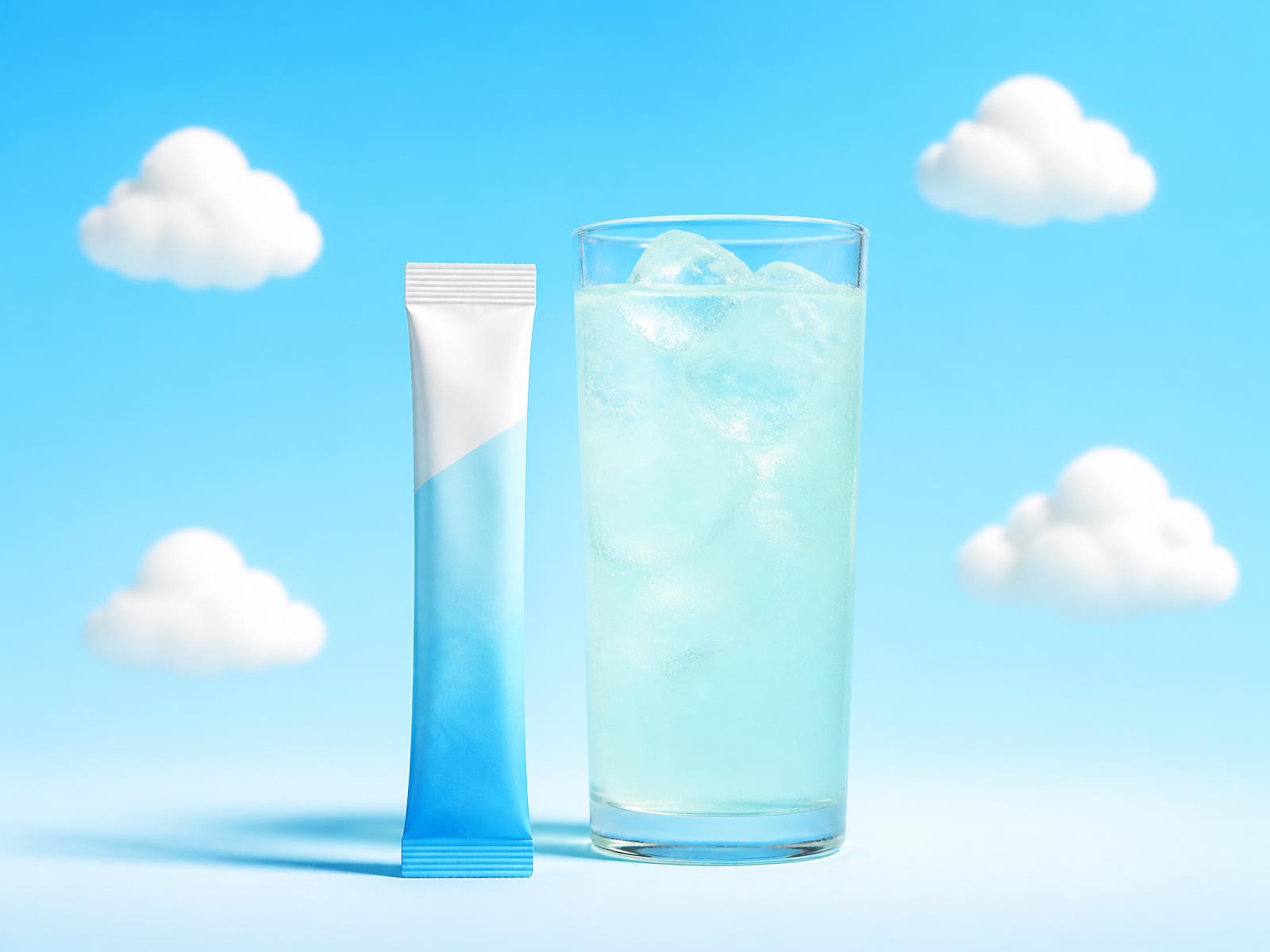
One stick. Five ingredients that earn their spot.
| Ingredient | Amount | Role | Why this dose |
|---|---|---|---|
| Creatine monohydrate | 4.5 g | Strength, power, recovery, cognition | Within the ISSN-recommended daily maintenance range; saturates muscle stores in 3–4 weeks without a loading phase. |
| Sodium | 500 mg | Replaces what sweat takes out | Covers ~1 hour of moderate-sweat training based on typical losses (500–1500 mg per litre of sweat). |
| Potassium | 300 mg | Muscle relaxation, nerve signalling, blood pressure balance | Pairs the sodium dose so the contraction/relaxation cycle has both ions present, and adds a meaningful chunk of the ~3,500 mg/day adequate intake most people miss. |
| Magnesium | 60 mg | Energy metabolism, muscle function, protein synthesis | Magnesium absorption drops sharply above ~100 mg per single intake; a daily dose your body can actually absorb beats a 400 mg mega-dose that mostly leaves in the toilet. |
| Vitamin B12 | 25 µg | Energy, nervous system, red blood cells | Active uptake saturates at ~1.5–2 µg per dose and passive diffusion adds ~1%, so 25 µg lands at roughly 3–4 µg in circulation — the daily target. Water-soluble, no accumulation. |
Creatine monohydrate · 4.5 g
The most-studied sports supplement on earth.
Why 4.5 g. Not 1. Not 10.
4.5 g/day sits in the maintenance range used across major creatine research. Less and you slow-walk saturation for weeks. More and you're paying for expensive urine. The ISSN agrees: 3–5 g/day, no loading phase needed. We dosed exactly that.
Strength & power output1
Creatine combined with resistance training reliably increases maximal strength, sprint power, and lean mass across age groups and training levels.
Faster between-set recovery2
Replenishes phosphocreatine stores faster between sets, so each set lands closer to your true working capacity instead of degrading over time.
Cognition under fatigue3
Daily creatine improves short-term memory and reasoning under sleep deprivation and demanding mental load — the brain is an energy-hungry organ too.
3–5 g/day, long-term1
Decades of randomised trials show no adverse effects on kidney or liver markers in healthy adults at standard maintenance doses.
"Creatine monohydrate is the most effective ergogenic nutritional supplement currently available to athletes for increasing high-intensity exercise capacity and lean body mass during training."
Why this amount
4.5 g/day sits inside the ISSN-recommended 3–5 g maintenance range. Muscle stores saturate over 3–4 weeks, no loading needed. Higher single doses don't add benefit — they add GI discomfort and yellow urine.

Sodium · 500 mg
The electrolyte you actually lose.
Water without sodium is just… water.
Most sticks dose sodium for marketing — 200 mg, "looks healthy on the label". We dose it for sweat. You lose hundreds of milligrams of sodium per litre of sweat, and water alone dilutes what's left in your bloodstream. 500 mg is what one hour of real training actually costs you.
What it does in the formula
Sodium drives fluid into the bloodstream and helps you actually retain what you drink. It keeps nerve-to-muscle signalling sharp during prolonged effort, and pulls glucose and amino acids into working muscle via co-transport.
The losses you're replacing7
Trained athletes lose roughly 500–1500 mg of sodium per litre of sweat. Heat and high sweat-rate genetics push that higher. 500 mg covers about an hour of moderate training for an average sweater.
Why this amount
Enough to make a real difference in one training session, without overshooting daily sodium targets for the days you don't train. Long, hot sessions? Drop a second stick.
Potassium · 300 mg
The other half of the muscle-signal pair.
The half of the equation everyone forgets.
Sodium gets the attention. But without potassium, your muscles can't relax between contractions — which is literally what cramps are. 300 mg pairs the sodium dose so the contraction/relaxation cycle has both ions present, and adds a meaningful chunk of the ~3,500 mg/day adequate intake most people miss.
Contributes to normal functioning of the nervous system4
Potassium ions drive the electrical signals your nerves use to fire muscles.
Contributes to normal muscle function4
Required for contraction and relaxation — low potassium shows up as cramps and twitches.
Contributes to the maintenance of normal blood pressure4
Helps balance the effect of sodium on the cardiovascular system.
Why this amount
300 mg pairs the sodium so the muscle-signal cycle has both ions present. Big enough to matter post-sweat, small enough to leave room for the potassium you should still be getting from food — bananas, potatoes, leafy greens are all better sources than any stick.
Magnesium · 60 mg
The cofactor running in the background.
Why we didn't just throw 400 mg in.
Every "premium" magnesium product on the shelf hits 200–400 mg per serve. They also send a meaningful share of users to the bathroom. Magnesium is used continuously by 300+ enzymes, and absorption drops sharply above ~100 mg per single intake — so a daily dose your body can actually use beats a mega-dose that mostly leaves in the toilet.
Contributes to a reduction of tiredness and fatigue5
One of the few nutrients with a directly authorised fatigue claim.
Contributes to normal energy-yielding metabolism5
Cofactor for 300+ enzymes that turn food into ATP.
Contributes to normal muscle function5
Required for proper contraction and the relaxation phase that follows.
Contributes to normal protein synthesis5
Supports the cellular machinery that builds and repairs muscle tissue.
Contributes to electrolyte balance5
Works alongside sodium and potassium to keep fluid distribution stable.
Why this amount
60 mg sits inside the absorption window the body actually uses in one go. At 200–400 mg per dose, magnesium reliably causes GI upset and laxative effects, and a smaller fraction is absorbed anyway. Spread intake across food + this stick — that's what the research supports.
Vitamin B12 · 25 µg
A daily dose because B12 doesn't stick around.
25 µg looks high. Here's what actually lands.
B12 absorption is rate-limited. Your gut can only grab around 1.5–2 µg per dose via the active (intrinsic-factor) route. Anything above that is picked up by passive diffusion at roughly 1%. So a "high" 25 µg dose actually delivers a sensible 3–4 µg into circulation — exactly the daily target for adults. The rest is water-soluble and leaves in urine. No accumulation, no risk.
Contributes to the reduction of tiredness and fatigue6
Helps you push through long days without crashing.
Contributes to normal energy-yielding metabolism6
Supports how your body turns food into usable fuel.
Contributes to normal functioning of the nervous system6
Backs steady focus, mood, and signal transmission.
Contributes to normal red blood cell formation6
Red cells move oxygen — the engine behind every rep.
Why this amount
25 µg looks high on paper but lands at ~3–4 µg into circulation — exactly the daily target for adults. We dose for actual uptake, not for the percentage on the label. Anything above that leaves in urine within hours.
Just as important
What we left out — on purpose.
What's not in the stick is part of the formula too.
Sugar.
Spikes insulin, crashes focus 45 minutes later. Not what you want mid-training.
Caffeine.
It's already in your coffee, your pre-workout, your tea. We're not adding to that pile.
Taurine, BCAAs, exotic adaptogens.
Either the dose that does anything won't fit in a stick, or the evidence isn't there. Both are reasons to leave them out.
Artificial colours.
No functional reason to add them. So we didn't.
The whole formula
Why these five ship together.
Creatine pulls water into the muscle cell — that's part of how it works. Sodium, potassium and magnesium make sure that water (and the electrical signal that follows it) actually arrives where it's needed. B12 keeps the energy-metabolism pathways running so the food you eat actually becomes the ATP you spend. Each ingredient does its job. Together they cover the whole chain — fluid balance, contraction, recovery.
In practice
What this means for your day.
The science, translated into what you'll actually notice.
Strength
Heavier lifts and more power output once your stores are saturated — roughly three to four weeks in.
Hydration
Sodium, potassium and magnesium in the ratios sweat actually takes out, so what you drink stays with you.
Daily energy
B12 and magnesium back energy-yielding metabolism and take the edge off midday fatigue.

The whole point
"We built this for the version of ourselves that trains every day, has a job, and can't be bothered measuring out four separate scoops. One stick. The doses we'd actually take."
— The Nubs team
Sources
Citations & regulatory note.
Every benefit on this page is drawn from the peer-reviewed sources below. Doses are chosen for what the body absorbs and uses — not for what looks good on a label.
- 1Kreider et al. — ISSN Position Stand on creatine supplementation. JISSN 2017. View source →
- 2Antonio et al. — Common questions and misconceptions about creatine supplementation. JISSN 2021. View source →
- 3Avgerinos et al. — Effects of creatine supplementation on cognitive function. Exp Gerontol 2018. View source →
- 4EFSA Panel on Dietetic Products, Nutrition and Allergies — Scientific Opinion on potassium-related health claims. EFSA Journal 2010. View source →
- 5EFSA Panel on Dietetic Products, Nutrition and Allergies — Scientific Opinion on magnesium-related health claims. EFSA Journal 2009/2010. View source →
- 6EFSA Panel on Dietetic Products, Nutrition and Allergies — Scientific Opinion on vitamin B12 (cobalamin) health claims. EFSA Journal 2010. View source →
- 7Sawka et al. — ACSM Position Stand on Exercise and Fluid Replacement. Med Sci Sports Exerc 2007. View source →